
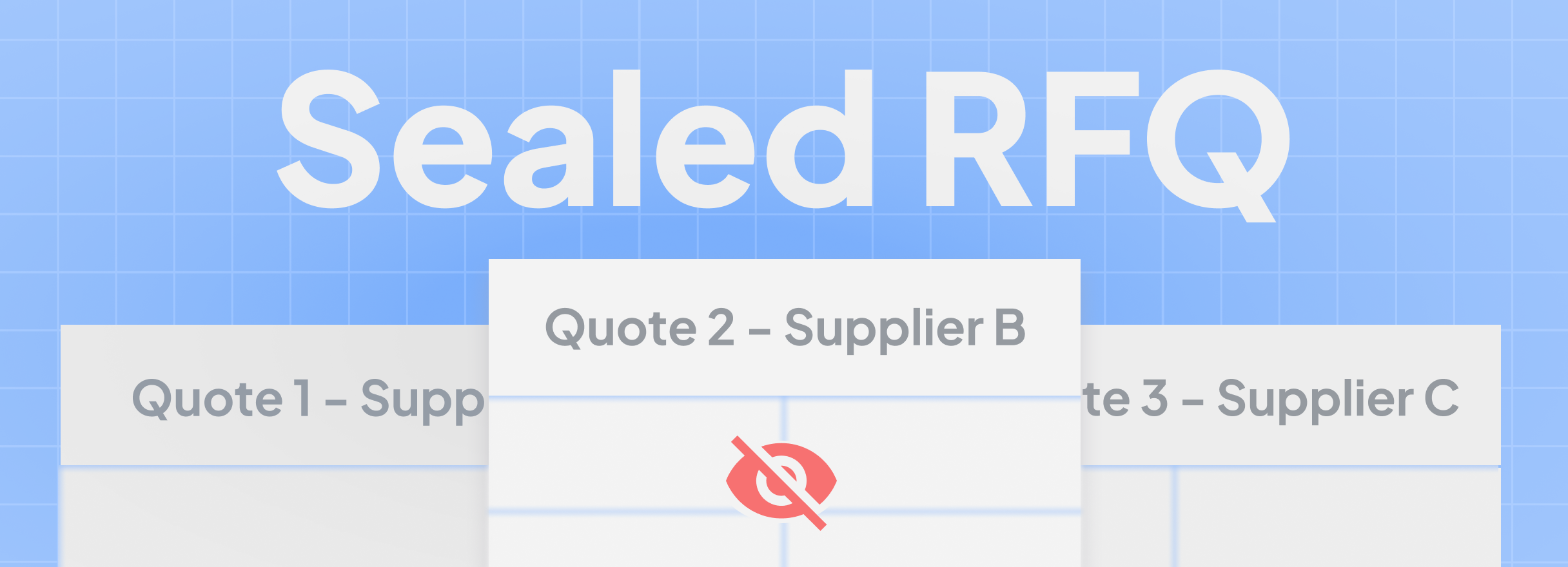
What is a Sealed RFQ?
A sealed RFQ is a request for quotation in which supplier responses are kept confidential until a specified deadline or authorized opening. Suppliers submit their prices and commercial terms independently, without seeing competing quotations. Depending on the organization’s rules, buyer access may also be restricted until the event closes.
The purpose is not simply to hide numbers. It is to preserve the independence of each quotation. Every supplier should price the same requirement using the information available to all invited participants, rather than reacting to an early bid, a disclosed benchmark, or another supplier’s position.
Is a Sealed RFQ The Same as Formal Sealed Bidding?
Not always. Terminology changes across industries, jurisdictions, and procurement systems.
In commercial sourcing, “sealed RFQ” commonly describes a confidential quotation event: suppliers submit responses that remain hidden until closing. In regulated public procurement, “sealed bidding” may be a formally defined contracting method with specific rules for solicitation, bid opening, evaluation, and award.
For example, the U.S. Federal Acquisition Regulation describes sealed bidding as a process built around invitations for bids, public opening, evaluation without discussions, and award based on the stated price-related factors. The U.S. General Services Administration also distinguishes an RFQ from a sealed bid solicitation or invitation for bids.
Other procurement regimes use RFQs within formal sealed processes. The practical lesson is simple: a company should define what “sealed” means in its own event and verify any legal or policy requirements that apply. An internal label does not replace the governing procurement rules.
How Does a Sealed RFQ Work?
A sealed RFQ separates quotation submission from quotation visibility. The buyer prepares the requirement and bidding rules, qualified suppliers submit independently, and the responses remain inaccessible to unauthorized users until the event closes.
- Define the requirement. Procurement confirms the scope, specifications, quantities, delivery requirements, commercial terms, and evaluation method before the RFQ is published.
- Set the sealing rules. The event documentation states who can submit, who can view submissions, whether revisions are allowed, and exactly when the quotations will become available for evaluation.
- Invite qualified suppliers. Each supplier receives the same RFQ package, deadline, submission instructions, and access to the same clarification information.
- Collect independent quotations. Suppliers enter pricing and terms without access to competing bids or signals that reveal another supplier’s position.
- Close the event. The system or procurement owner stops further submissions and revisions at the published deadline, subject to the stated late-bid rules.
- Open the responses under controlled access. Authorized evaluators receive access at the defined time. The event record should show when bids were submitted, revised, opened, and reviewed.
- Evaluate and award. The team checks compliance first, then compares price and the other disclosed criteria. Approvals and the final decision remain connected to the original responses.
See How a Sealed RFQ Works in WorkFish
The WorkFish workflow shows how a buyer can configure the bidding event, collect supplier responses, and keep the RFQ process connected through evaluation and award. The video should be embedded here so readers can see the operating controls immediately after learning the process.
What Information Does a Sealed RFQ Protect?
The core protected information is each supplier’s quotation before the event closes. That may include unit prices, total price, discounts, freight, payment terms, lead time, capacity commitments, exceptions, and other commercially sensitive inputs.
However, “sealed” can describe different access models:
- Supplier-confidential: suppliers cannot see one another’s bids, but designated buyer users can view them as they arrive.
- Evaluator-confidential: submissions are hidden from the evaluation team until the deadline, while a restricted administrator manages the event.
- Fully sealed until close: neither competing suppliers nor buyer-side evaluators can view quotation content before the opening time.
Procurement should name the model explicitly. Calling an RFQ sealed while allowing broad internal access creates a false sense of control and makes the process harder to defend later.
What is The Difference Between a Sealed RFQ and an Open RFQ?
The main difference is the competitive information available before the deadline. A sealed RFQ preserves independent pricing. An open or visibility-enabled RFQ may expose signals such as a leading price or supplier rank so bidders can respond during the event.
Neither format is universally better. The correct design depends on the category, supplier market, sourcing objective, regulatory environment, and buyer’s willingness to negotiate after the first submission.
When Should Procurement Use a Sealed RFQ?
A sealed RFQ is most useful when procurement can define the requirement clearly and wants suppliers to submit independent commercial offers.
- The product or service specification is complete enough for suppliers to price the same requirement.
- Several qualified suppliers can compete under the same rules.
- Pricing or commercial terms are sensitive and should not be exposed before closing.
- The organization needs a defensible record of submission, opening, evaluation, and approval.
- Buyer-supplier relationships or incumbent pricing could otherwise influence the competition.
- The award can be evaluated using criteria established before the bids are opened.
A sealed RFQ is less suitable when the requirement is still ambiguous, suppliers need to propose different solution approaches, or the buyer expects significant negotiation before the commercial scope can be compared. In those cases, an RFI, RFP, negotiated RFQ, or multi-stage sourcing event may fit better.
How Does Confidential Bidding Protect Supplier Pricing?
Confidential bidding reduces the number of opportunities for a supplier’s price to influence another response before the event closes. When access is properly controlled, an early quotation cannot become an informal target for later bidders, and a supplier cannot simply position itself a small amount below a visible competitor.
This does not guarantee the lowest price or eliminate every form of bias. It creates a more disciplined information boundary. The quality of the outcome still depends on market competition, specifications, supplier qualification, evaluation design, and the integrity of the opening and award process.
The strongest protection comes from combining confidentiality with evidence: timestamps, access logs, revision history, consistent Q&A, documented evaluation criteria, approval records, and a clear connection between the winning quotation and the resulting contract or purchase order.
What Can Compromise a Sealed RFQ?
A sealed label is not enough. The event can still lose credibility when its operating controls are weak.
- Quotes arrive in personal inboxes where access and forwarding cannot be controlled.
- Some buyer users can view early submissions without a documented business need.
- One supplier receives clarification that is not shared with the others.
- The buyer changes requirements without issuing a formal amendment or extending the deadline appropriately.
- Suppliers submit different pricing structures, making comparison subjective after opening.
- Late bids, withdrawals, and revisions are handled inconsistently.
- Evaluation criteria change after the team sees the prices.
- The award decision is separated from the bid record, approvals, and supplier communication.
These failures are process problems, not merely document problems. A better template helps, but the workflow must enforce the rules the RFQ promises.
How do You Run a Sealed RFQ Step by Step?
The seven steps above show what a sealed RFQ event looks like end to end. The checklist below turns that into a working procedure your team can follow event by event, with more detail on the controls that keep the seal defensible.
1. Define What “Sealed” Means For The Event
State whether bids are hidden from other suppliers, buyer-side evaluators, or both. Identify the authorized event administrator and the exact opening time. Do not leave the access model to assumption.
2. Standardize The Response Structure
Require suppliers to use the same units, currencies, pricing fields, delivery terms, and exception fields. Separate unit price from freight, tax, duties, surcharges, implementation fees, and optional items. Sealed bids are only useful when the opened responses can be compared.
3. Publish The Rules Before Accepting Submissions
Document the deadline and time zone, revision policy, late-bid treatment, clarification process, evaluation criteria, award method, and any right to reject or cancel the event. Suppliers should understand the process before they commit pricing.
4. Give Every Supplier The Same Information
Centralize questions and distribute material answers to all participants. If a clarification changes the scope, issue an amendment and give suppliers enough time to revise their responses.
5. Control Submissions And Revisions
Record when each response is created, submitted, withdrawn, or revised. Once the deadline passes, the event should prevent further changes unless the published rules allow a documented exception.
6. Open Bids Through An Authorized Workflow
Access should begin only for the users responsible for compliance review and evaluation. For higher-risk events, organizations may require two-person opening, approval gates, or a formal opening record.
7. Evaluate Compliance Before Comparing Price
Confirm that each response meets mandatory specifications, documentation, and submission requirements. Then compare pricing and other disclosed commercial factors. A low price should not override a material failure to meet the requirement.
8. Preserve The Award Trail
Keep the original RFQ, amendments, supplier questions, submitted quotations, evaluation record, approvals, award communication, and resulting purchasing document connected. This provides context when finance, leadership, auditors, or suppliers later ask how the decision was made.
What Should Sealed RFQ Software Control?
A sealed RFQ managed through email depends heavily on individual behavior. A sourcing platform can make the rules more consistent by enforcing access, deadlines, and event history at the workflow level.
Useful controls include:
- role-based access to supplier responses;
- submission and revision timestamps;
- automatic closing at the published deadline;
- configurable supplier visibility for bids, lowest prices, and rankings;
- shared clarification and amendment workflows;
- structured pricing and commercial response fields;
- bid history and audit tracking;
- evaluation, negotiation, award, and approval workflows;
- a controlled transition from the awarded RFQ to a contract or purchase order.
WorkFish connects RFQ creation, supplier participation, bid communication, evaluation, negotiation, award approvals, bid history, contract creation, and ordering in one procurement workflow. The Workfish RFQ platform also gives buyers control over the competitive information surfaced during bidding, so the event configuration can match the sourcing strategy rather than forcing every RFQ into the same format.
For a sealed event, the configuration should be reviewed before publication and tested from both the supplier and evaluator perspectives. Procurement needs to know exactly what each role can see before, at, and after the deadline.
Conclusion: Confidentiality Must be Built Into The Workflow
A sealed RFQ protects supplier pricing by controlling when and by whom quotation information can be seen. That boundary can reduce premature influence, strengthen supplier confidence, and give procurement a more defensible decision record.
The seal alone does not create a good sourcing outcome. Procurement must define the requirement clearly, give every supplier the same information, standardize the response, enforce the deadline, control access, and preserve the complete award trail. When those controls remain connected from RFQ creation through contract or purchase order, confidential bidding becomes an operating model rather than a promise written in the event instructions.
